The Challenge
Users who routinely process small data files were forced through SaaS upload flows that demanded accounts, leaked sensitive data to third-party servers, and broke under offline conditions.
Frontend · Web Apps
Browser-native toolkit for splitting CSVs, formatting JSON, editing PDFs, removing image backgrounds, and a dozen more file operations — runs entirely client-side with no upload, no signup, no tracking.
Visit live site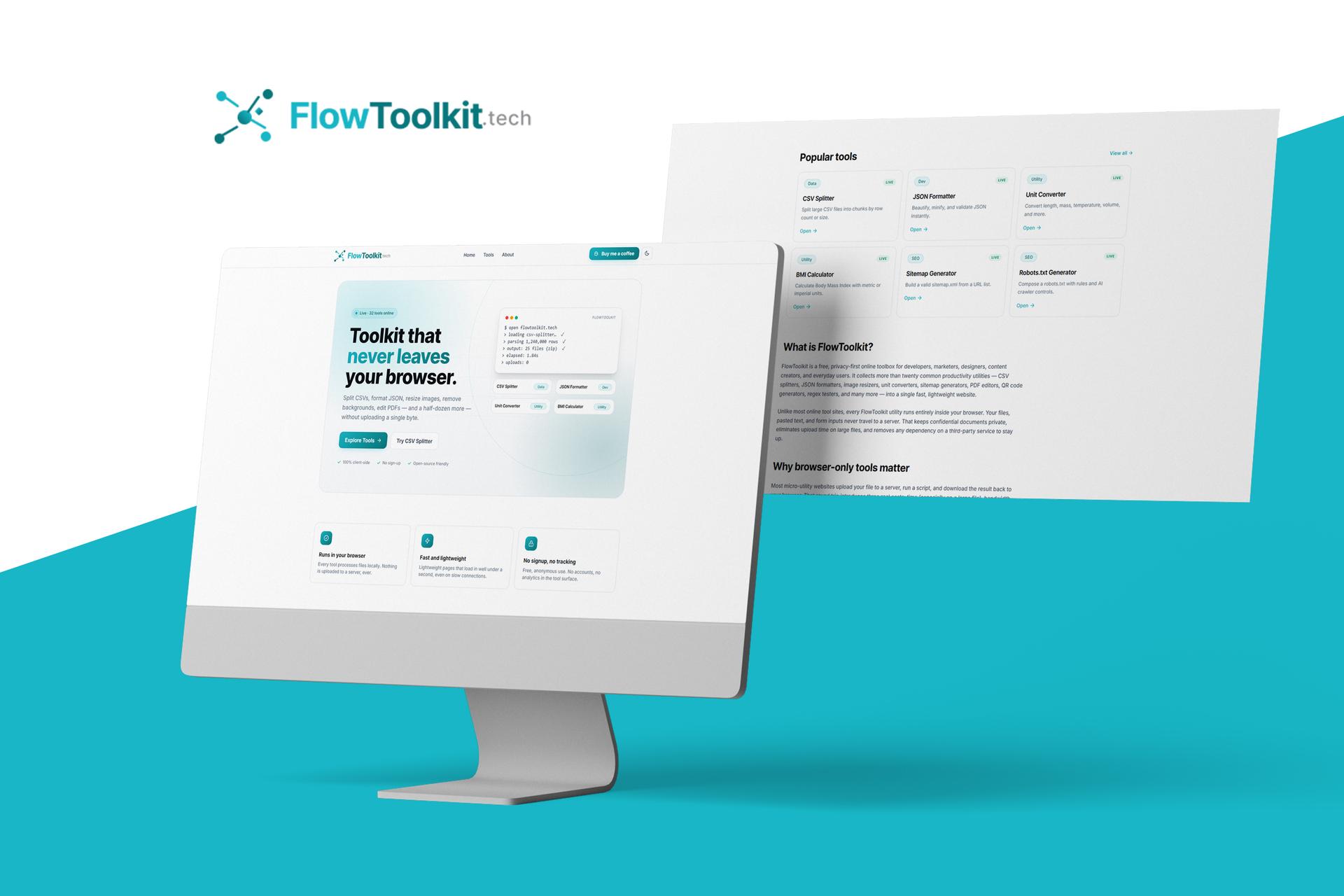
Screens
Users who routinely process small data files were forced through SaaS upload flows that demanded accounts, leaked sensitive data to third-party servers, and broke under offline conditions.
Engineered every tool — CSV splitter, JSON formatter, PDF editor, background remover, image converter — as a fully client-side module. Heavy parsing pushed to WebAssembly workers, zero analytics in the tool path, and a unified toolkit shell delivered through Next.js with edge caching.
What we delivered
This engagement combined several of ConfiaTech's core capabilities. Each contributed a specific outcome to the final product.
Next.js, React, Angular, Astro, WordPress. Pixel-precision UIs that load instantly and feel inevitable.
Research-driven design systems. Interfaces that convert and outlast trends.
Automated test suites, regression coverage, and manual QA cycles that keep releases stable across every browser and device.
Pipelines, container orchestration, and infrastructure-as-code so every commit ships safely to production with observability baked in.
How we delivered it
Every case study on this site follows the same delivery spine — the four-phase process we have refined across many production engagements.
Stakeholder interviews, technical audit, success metrics, phased roadmap.
User research, design systems, interactive prototypes approved before code.
Two-week sprints, weekly demos, automated testing, continuous deployment.
Production rollout, observability, incident response, feature evolution.
Every contributor on the engagement had at least five years of production experience. No learning on the client dime.
Outcomes — not deliverables — drive the roadmap. Weekly demos report progress against the metric, not against the backlog.
Production observability, incident playbooks, and handoff documentation ship with every release.
The same engineers who built the product support and evolve it. Institutional knowledge stays inside the engagement.
Walk us through your problem. Within one business day a expert engineer will recommend the engagement model, team composition, and timeline that maps closest to this case study.
Start a conversation